
Protective Styling That Actually Protects: 5 Rules for Fine Strands
Most 'protective' styles destroy fine hair at the perimeter. Use these 5 rules to braid, twist, and wig WITHOUT thinning your edges or snapping your length.
Protective styling is supposed to tuck your ends away and let your hair rest. For fine natural hair, the wrong protective style does the opposite — it puts constant tension on the finest strands you own (your edges and nape) until they give out.
Rule 1 — No pain. Ever.
If your scalp throbs, your style is too tight. Tell your braider to loosen the first row at the hairline before you leave the chair, not after.
Rule 2 — Smaller parts, lighter hair
- Use smaller braiding hair (less weight per follicle).
- Knotless every time — never knotted at the root for fine strands.
- Cap installs at 6 weeks max. After that, new growth tangles into the braid and snaps on take-down.
Rule 3 — Moisturize the BRAID, not just the scalp
Weekly: dilute leave-in 50/50 with water in a spray bottle. Mist the braids, seal with a light oil. Dry braids snap fine hair from the inside out.
Rule 4 — Wigs need a barrier
Wear a satin or stocking cap UNDER the wig. Bare cornrows + lace = friction. Friction on fine hair = breakage in 14 days.
Rule 5 — Rest in between
Two weeks of loose, low-tension styling between every protective install. Your follicles need recovery time or you'll thin out the perimeter for good.
Protective is a verb, not a noun. The style only protects if you maintain it.
Was this helpful?
Let Val know, share it with a friend, and save it for your next wash day.
Have a question about your own strands?
Ask Val — the free fine-hair assessment helps her point you to the care your hair actually needs.
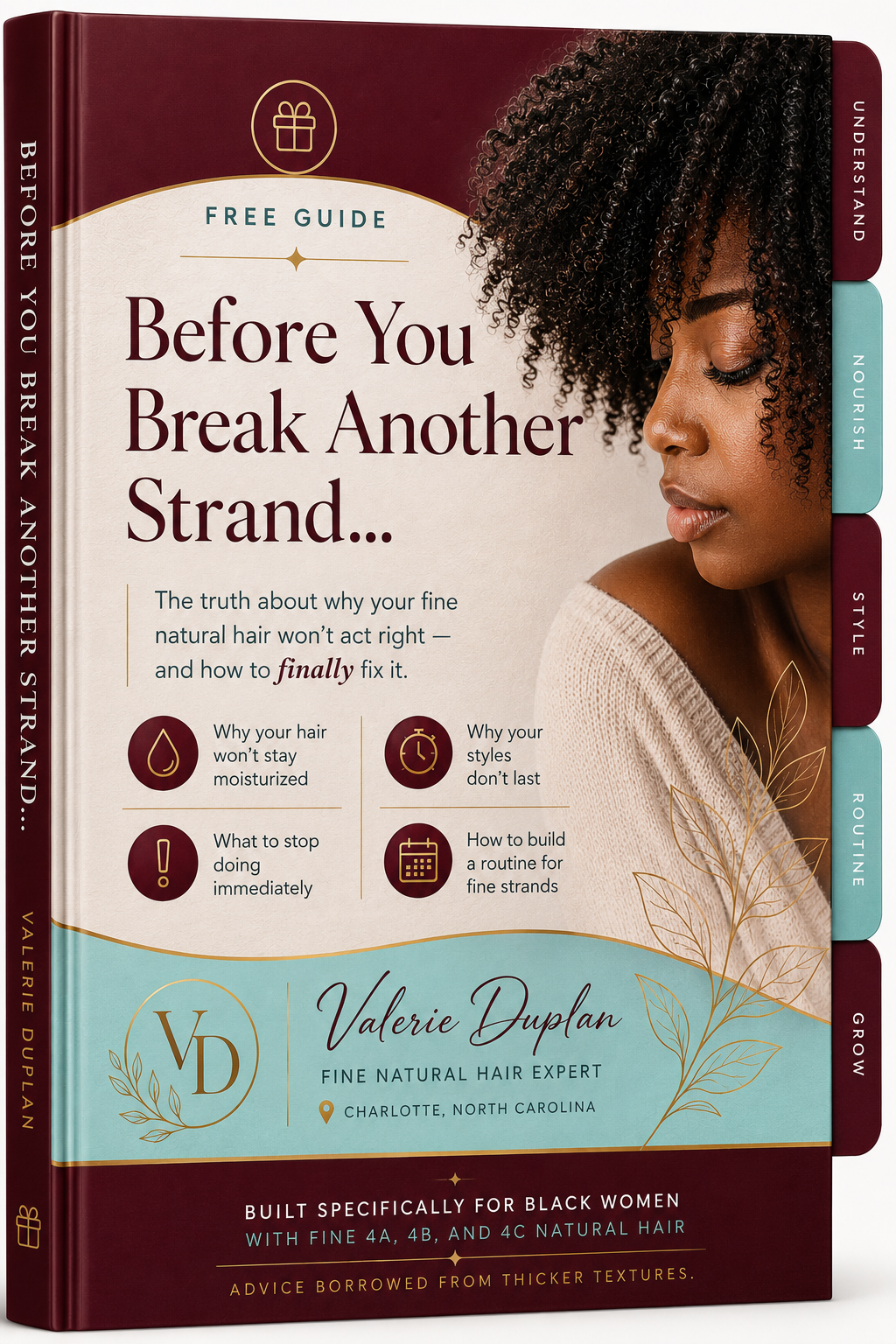
Free download
Struggling with fragile fine hair?
Get Val's free guide to stop chronic breakage — what to stop doing this week, and the first three moves that keep your length. Enter your email and it lands in your inbox.
No spam. Unsubscribe anytime.